Math 342: Problem 7.3.17It's always entertaining when your teacher gets stuck on a homework problem during a review session for an exam. The problem in question, Exercise 17 from Sec. 7.3, concerns a greeting card company that stashes its cards in two warehouses and wants to ship them as economically as possible to its outlets in San Jose and Memphis. Since I think you're owed a proper explanation of how to solve the problem, let me pick apart the many components of this exercise and try to give you a good and reasonably straightforward solution.
First of all, we're given a broad (and perhaps confusing) hint about what to use as variables. Let's assign them this way:
x will be the number of boxes of cards shipped from Warehouse I to San Jose and
y will be the number of cards shipped from Warehouse I to Memphis. Since San Jose really wants 350 boxes, it will still need 350 −
x boxes (if any) after receiving the shipment of
x boxes from Warehouse I. Therefore the balance, 350 −
x, must come from Warehouse II. Similarly, since Memphis wants 250 boxes, it will receive
y from Warehouse I and 250 −
y from Warehouse II.
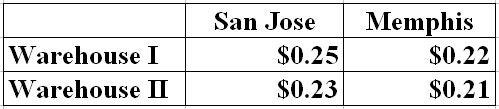
The object of this exercise is to minimize the total shipping costs in filling the orders from the two stores. We're given this cost grid:

We conclude therefore, that the total cost of shipping the cards from the two warehouses to the two stores will be
z = 25
x + 23(
x − 350) + 22
y + 21(250 −
y).
I'm expressing the cost in pennies so as to dispense with the decimal points for now. As we saw in class, when you multiply this out and collect like terms, the object function reduces to
z = 2
x +
y + 13,300.
Now we need to find a feasible region in the
xy plane at whose vertices we can check the object function. Let's list what we know:
Warehouse I has only 500 boxes of cards in stock, so
x +
y ≤ 500.
Warehouse II has only 290 boxes of cards in stock, so
(350 −
x) + (250 −
y) ≤ 290.
When we remove the parentheses and collect like terms, this becomes
600 −
x −
y ≤ 290,
so
−
x −
y ≤ −310,
and (dividing by −1 and reversing the inequality)
x +
y ≥ 310.
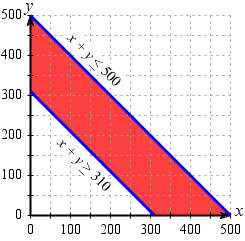
When we graph these two inequalities together, we get two parallel lines and the region between them:

We already know that
x and
y are both nonnegative, so we care only about points in quadrant I. We must also have 350 −
x ≥ 0 and 250 −
y ≥ 0 since these are the number of boxes being shipped from Warehouse II. The first condition implies that
x ≤ 350 and the second requires that
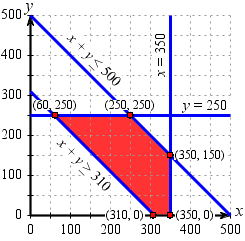
y ≤ 250. When we include these conditions on the graph, we get our feasible region for this problem:

We can now start reading off our vertices. The points (310, 0) and (350, 0) lie on the
x axis. The points (350, 150) and (250, 250) are also easy to read from the graph. The remaining vertex lies on the intersection of the line
y = 250 with the line
x +
y = 310. If we plug in 250 for
y, we find that
x must be 60. Our last point is therefore (60, 250). We can fill in our points and compute the values of the object function at each one:

As you can see, the object function is minimized when
x = 60 and
y = 250. That means San Jose gets 60 boxes from Warehouse I and 350 −
x = 350 − 60 = 290 boxes from Warehouse II, while Memphis gets all of its order from Warehouse I (nothing from Warehouse II). Since we've been expressing the cost in pennies, we should convert it to dollars as we conclude that the minimum shipping cost is $136.70.
Note: This problem could have been done as a four-variable linear programming problem, using the techniques that appear later in this chapter. However, with a creative choice of variables it was possible to solve it with only two variables. That permitted us to do it with a graph in the
xy plane. Unfortunately, we won't be going on to those sections of the book that allow us to do more complicated linear programming problems.


 In some ways, Calculus III is a re-run of Calculus I (derivatives) and Calculus II (integrals). We are going to differentiate and integrate functions again, but this time in higher dimensions. Instead of limiting ourselves to functions of one variable, as we did in the past, we are going to deal with functions that have two or three (or more) variables. Calculus III will therefore involve familiar operation, but in unfamiliar contexts. Your basic differentiation and antidifferentiation skills will be employed in new and more realistic situations. In particular, physics students will recognize that many of our Calculus III theorems relate directly to discoveries in electromagnetism and the properties of gravitation.

 It may seem greedy to complain that we had only a year to bid farewell to Sharon, but I'm going to complain anyway. We have been robbed of a dear friend, a cherished colleague, and a great teacher. We are weakened in every way by her loss. The entire mathematics department—the whole college—is in mourning. I can scarcely even begin to imagine the magnitude of the grief among her family members.
 This term I am teaching four classes covering three courses: two sections of Math 342 (Business Applications Math) and one section each of Math 350 (Calculus for the Life and Social Sciences I) and Math 370 (Precalculus). I've posted the syllabi as pdfs on my public directory (see the sidebar for the link). Welcome. If you have any questions or if you are doing the assignments in Quiz 0, you can e-mail me by clicking the link in the sidebar.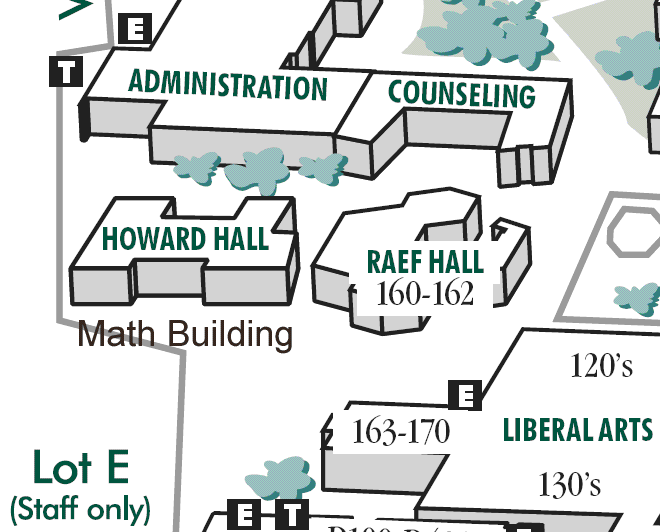
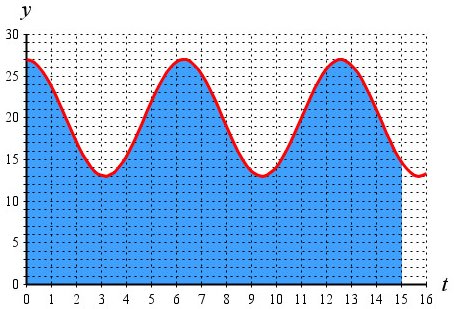 In the second figure, I've drawn in the lines y = 13 and y = 27 to mark off the low and high points of the velocity curve. If the object were traveling only 13 ft/sec for 15 sec, then the distance it travels would be just (13 ft/sec)(15 sec) = 195 ft. That's the area of the blue rectangle that represents a lower bound on the area under the red curve. On the other hand, if the object always traveled 27 ft/sec (the upper bound on velocity), then the distance traveled would be (27 ft/sec)(15 sec) = 405 ft.
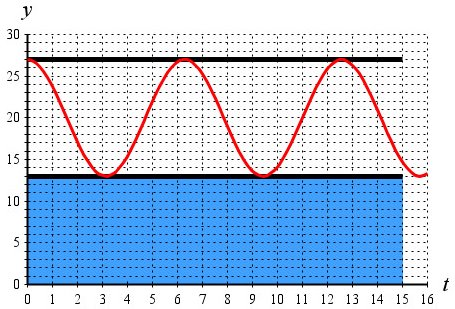 We have now figured out that the distance traveled is somewhere between 195 ft and 405 ft. That's a pretty broad range, to be sure, but we could make it better by using less extreme bounds. For example, we could try drawing triangles inside the humps of the cosine curve to estimate the area we left off while computing the lower bound. That should help. At some point, though, we would probably want something better than computing lots of different estimates. When we have the right calculus tools available, we'll be able to show that the exact distance traveled is 300 + 7 sin 15 ≈ 304.55 ft.
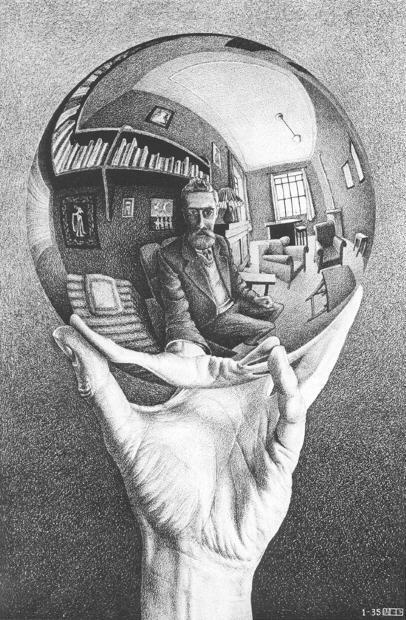 M. C. Escher's work will be on display at the Crocker Art Museum in Sacramento from June 10 to September 3 of this year. M. C. Escher: Rhythm of Illusion was originally organized by the Portland Art Museum and features 70 examples of the artist's surreal art. Many of Escher's drawings are familiar to college students, especially since they are so commonly displayed in the offices and classrooms of math teachers.
 But it's not quite that simple when we start considering vector quantities instead of scalar. When direction enters into it, we have to account for the fact that work can be performed by a force that is not entirely aligned with the direction of the distance traveled. The cosine of the angle of divergence comes to the rescue:
 If we use standard vector notation and consider what work actually equals, we end up looking at the following scalar product, which is the parallel component of F times the length of d:


